Everything in DockRun

One app for how
you actually work on a Mac.

Docks, workspaces, workflows and widgets, explained one by one: what each does, where to find it in the app, and what needs Pro.

features described below
42

features described below

feature areas
4

feature areas

of them need Pro
11

of them need Pro

Macs per plan: 1, 3, 10 or 30
1-30

Macs per plan: 1, 3, 10 or 30

Apple Silicon, macOS 13+
13+

Apple Silicon, macOS 13+

notarized by Apple
✓

notarized by Apple

Docks and palette

Docks, palette and everything on the dock

A floating dock you can place on any edge, a palette that opens with Option-Space, and pins for apps, folders, files, links, workspaces and workflows. You choose how it looks and how much of the macOS Dock it replaces.

Floating dock

A dock that sits on the screen edge you pick and can stand in for the macOS Dock.

  • Edge: bottom, top, left or right. A drag handle lets you move it anywhere else.
  • Auto-hide: it slides away when the pointer leaves and comes back at the screen edge.
  • Keep windows clear of the main dock: other apps' windows stop at its border (needs Accessibility; paused while Auto-hide is on).
  • Hide while an app is full screen, so it never covers a video or a presentation.
  • Steps aside while Mission Control, App Exposé or Launchpad is open, then fades back.

Where in the app: Settings > Floating Dock
Replace the macOS Dock

Use DockRun as your everyday dock and keep the system one out of the way.

  • "Hide the macOS Dock while DockRun is running" sets it to auto-hide with a very long delay.
  • Your original Dock settings are put back when DockRun quits normally.
  • DockRun asks you to confirm before it changes the system Dock.

Where in the app: Settings > Floating Dock > Replace the macOS Dock
Multiple docks

Pro

Give each context its own dock, with its own pins, edge and position.

  • New Dock is in the dock's "…" menu and on the Docks page. The free version has 1 dock; Pro has no limit.
  • Rename a dock, change its edge or close it from its own menu. Closing asks first.
  • Drag a pin from one dock onto another to move it.
  • Docks are saved and come back after a relaunch.

Where in the app: Dock "…" menu > New Dock; DockRun window > Docks

Pins for everything you open

Pin what you reach for most; one click runs it.

  • Pin apps, folders, files, links, workspaces and workflows. Drop an app or file on the dock to pin it, and drag to reorder.
  • A folder pin lists what is inside (folders first, 40 items). Click an item to open it, or choose Open in Finder.
  • Add spacers (small, medium, large) and dividers to group pins.
  • The eye on the Docks page hides a pin without removing it; Select hides, shows or removes several at once.
  • Right-click a pin > Change Icon… to use your own picture.

Where in the app: DockRun window > Docks; Settings > Dock

Running apps and minimized windows

See what is open, like the second half of the macOS Dock.

  • Open apps that are not pinned appear after your pins; pinned apps that are open get a small dot.
  • Click to switch to an app. Right-click to quit it or choose Keep in Dock.
  • Windows you minimized appear after the running apps; a click restores them. This needs Accessibility permission.

Where in the app: Settings > Floating Dock > Show running apps

Zoom on hover

The icon under the pointer grows and its neighbours follow.

  • A slider from Off up to about 120%.
  • Reduce Motion turns it off.

Where in the app: Settings > Dock Style > Zoom on hover

Dock Style

Change how the dock looks, with a preview over a light and a dark desktop.

  • Background: Liquid Glass, Solid or Transparent.
  • Nine colour themes: Automatic, Classic, Midnight, Graphite, Ocean, Sunset, Forest, Neon, Mono.
  • Icon colour: keep each app's colours, or draw every icon as a white, black or accent silhouette.
  • Icon size, gap between items and scale of the whole dock.
  • Export or import a preset (.dockrun file) with the style, icon size, main-dock pins and your replaced icons.

Where in the app: Settings > Dock Style

Trash on the dock

A Trash item at the end of the main dock.

  • Click to open the Trash.
  • Drop files on it to move them to the Trash; they stay recoverable from there.
  • The icon shows whether the Trash is empty or full.

Where in the app: Settings > Floating Dock > Show Trash

Command palette

Open it with Option-Space and reach apps, files, workspaces, workflows and settings from the keyboard.

  • Opened with nothing typed, it shows a grid of Recent items and every installed app, A to Z.
  • Arrow keys move through the grids; Return opens the selected tile.
  • Narrow a search with a prefix: app:, ws:, wf:, file:, action:, url: or setting:.
  • Cmd-P pins the selected result to a dock; with several docks you choose which one.

Where in the app: Option-Space (changeable in Settings > Shortcuts)

Workspaces and workflows menu

A button on the dock lists your workspaces and workflows so you can run one without opening a window.

  • Hover a row to see a play button; click to launch the workspace or run the workflow.
  • A close button on a row quits what that run opened, after asking.
  • Workspaces and workflows can also be pinned to the dock as ordinary pins.

Where in the app: The workspaces button on the dock

How it works

  1. Choose where it sits

    In Settings > Floating Dock pick the screen edge, and turn on Auto-hide or Keep windows clear if you want them.

  2. Pin what you use

    Drop apps, folders and files on the dock, or press Option-Space, select a result and press Cmd-P.

  3. Make it yours

    In Dock Style choose a background, a colour theme, icon size and Zoom on hover. Add spacers to group pins.

  4. Add a second dock if you need one

    Choose New Dock from the "…" menu (Pro), then drag pins between docks.

A day with it
In the morning you press Option-Space, type ws: and the name of your project workspace, and press Return. Its apps, folders and links open. The Slack and Mail pins sit on a second dock on the right edge, and you drag Figma over to it when you need it close.
Workspaces

Open a whole project, and put every window where it belongs

A workspace is a saved list of apps, folders, files and links. One click, shortcut or dock pin opens all of it, arranges the windows, and later closes only what it opened.

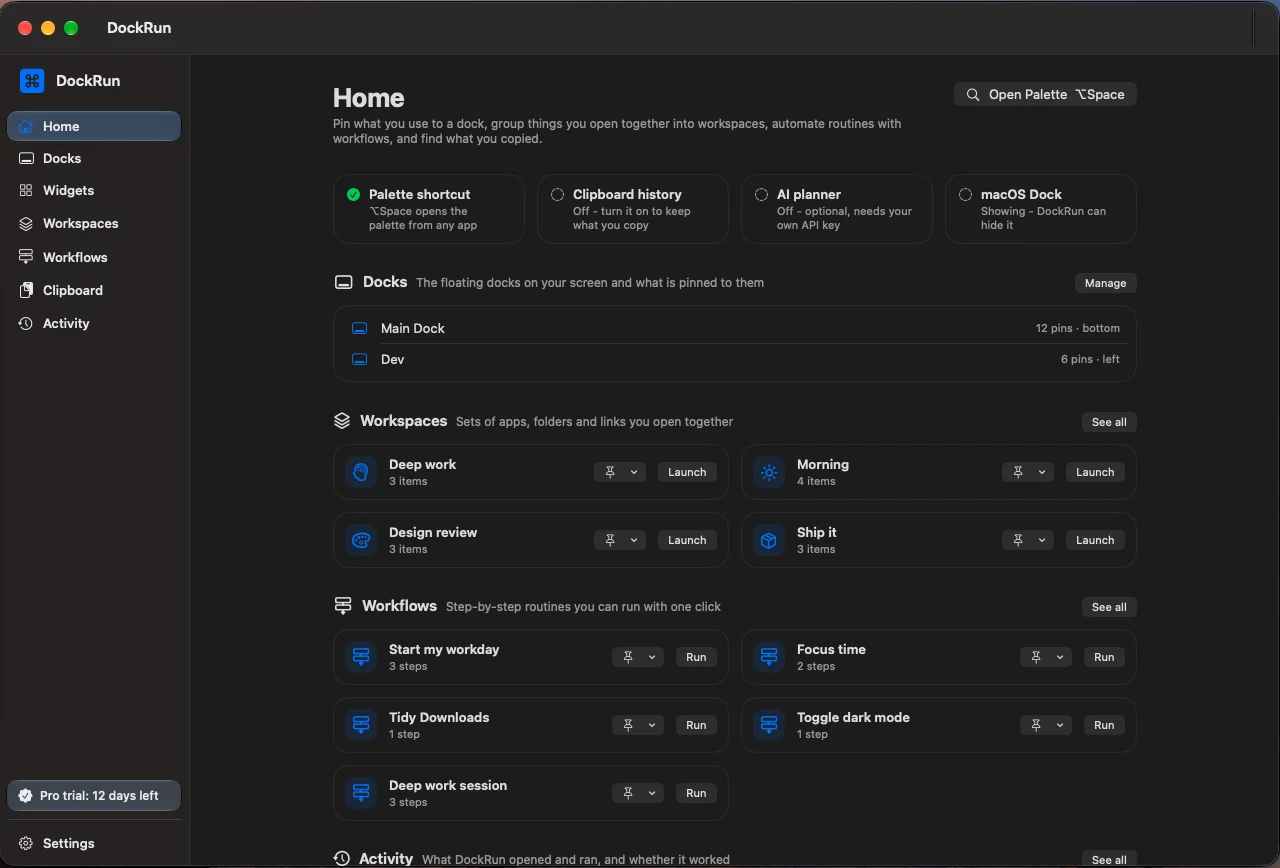
The DockRun hub: docks, workspaces and workflows in one place

Apps, folders, files and links in one list

Build a workspace by adding items or dropping them in. Each item can be turned off without deleting it.

  • Item types: app, folder, file, web link, Chrome profile with pages
  • Up to 50 items per workspace, 80 characters for the name
  • A folder or file you move or rename is found again; a file in the Trash is never opened
  • Deleting a workspace removes only DockRun's record, never your apps or files

Where in the app: DockRun window > Workspaces

Chrome profile with its pages

Open Google Chrome in a specific profile, such as Work, with the pages you need already loaded.

  • Pick the profile by the name Chrome shows
  • Add one or more pages (http and https)
  • Chrome only; Brave, Edge and Arc are not supported

Where in the app: Workspace editor > Add > Add Chrome Profile…

Open a project with the app you choose

A folder or file can open in a specific app, such as a project folder in VS Code, instead of the default one.

  • Choose the app per item with Choose app…
  • The window of that project can be arranged like any app window

Where in the app: Workspace editor > an item's menu

Launch with live progress, cancel and retry

Items open one by one, in order, or up to four at a time. You see each item's result, and one failure never stops the others.

  • Cancel stops new items from starting; the rest are marked cancelled
  • Retry failed items without reopening the ones that worked
  • If an app is already running: bring it forward, or skip it
  • A large workspace (8 items or more by default) asks before opening; you can change this in Settings

Where in the app: Workspace editor > Launch

Windows placed where you want them

Give each app a position and its window goes there when the workspace opens it. Presets are free.

  • Left, right, top and bottom half; the four corners; fill the screen; centred
  • Presets use the screen under the pointer
  • Needs Accessibility permission; if it is missing, the app still opens and the report says why

Where in the app: Workspace editor > an app's window menu

Capture a custom layout, per display

Pro

Arrange the windows by hand, then capture them. The positions are saved as fractions of the display, so they still fit if the resolution changes.

  • Capture Layout remembers where each app's window is now
  • Capture Windows adds every project open in Xcode, VS Code, Cursor, VSCodium, Windsurf or a JetBrains IDE, with its position
  • Each position remembers its display; if that display is not connected, the one under the pointer is used
  • A captured position replaces the preset; your data is kept if Pro lapses

Where in the app: Workspace editor > Items > Capture Layout / Capture Windows

Save Current Setup

Set up your desk by hand once, then turn it into a workspace in one click.

  • Free: saves the apps that are open (except Finder and DockRun)
  • Pro: also saves Finder folder windows and the tabs of Safari and Chrome
  • macOS asks once for Automation permission to read Finder and the browsers
  • The new workspace is named with the date and time; rename it afterwards

Where in the app: Workspaces page > Save Current Setup…

Close what the workspace opened

Close ends the session. It asks first, and shows the list of what it will close.

  • Quits only the apps that launch opened; apps already open before stay open
  • For a Chrome profile, closes only the windows that launch opened, never Chrome itself
  • Finder and DockRun are never quit
  • Apps with unsaved work ask to save, as with Cmd-Q

Where in the app: Workspace editor header, after a launch from DockRun

Back up, share and the free limit

Export workspaces to a .dockrun file to back them up or move them to another Mac. The free version includes 3 workspaces.

  • A .dockrun file is plain JSON; paths in your home folder are saved relative to it
  • Importing always adds copies and never overwrites what you have
  • Exporting is part of Pro; free users can still import, up to the 3-workspace limit

Where in the app: Workspace editor > Export; Settings > Data

How it works

  1. Collect the items

    Add apps, folders, files, links or a Chrome profile, or use Save Current Setup to start from what is open now.

  2. Place the windows

    Choose a position for each app, or arrange the windows yourself and capture the layout.

  3. Launch it your way

    Press Launch, click the dock pin, use the shortcut or open a link. Watch each item's result and cancel if needed.

  4. Close when you are done

    Close asks first, then quits only what that launch opened.

A day with it
Start my work day: a workspace opens your editor on the project folder in the left half, Chrome in your Work profile with the tracker and mail in the right half, and Slack in a corner. At six you press Close, check the list, and the apps it opened quit.
Automation

Workflows, triggers, scripts and integrations

Chain steps into a workflow, run it from the dock, a schedule, a Mac event, a link, the terminal or an AI client. Every step goes through the same checks, so automation never skips a confirmation.

Workflow builder

A workflow is an ordered list of steps. Each step is one action, with its own time limit and a choice to stop or continue if it fails.

  • Up to 50 steps and 20 variables per workflow; step time limit 1 to 300 seconds (30 by default)
  • Turn a step off without deleting it; give a step your own label
  • Dry run shows what each step would do without executing anything
  • The workflow is validated before it starts; one that fails validation never runs. Workflows cannot run other workflows

Where in the app: Menu bar > Workflows…

Steps: apps, files, scripts, shortcuts, requests

Open things, run code, press keys or call a web service from one place.

  • Open an app, a file, a folder or a link; reveal in Finder; open a Chrome profile; launch or close a workspace
  • Run Script in zsh, bash, AppleScript, Python, Node, Ruby or Perl, from inline code or a script file (stops after 60 seconds)
  • Press Keyboard Shortcut such as cmd+shift+4, optionally in a chosen app (needs Accessibility permission)
  • Run Apple Shortcut by name and use what it returns (Pro)
  • HTTP request with GET, POST, PUT, PATCH or DELETE; the access token is kept in the Keychain, not in the workflow (Pro)

Where in the app: Workflow editor > Add Step

19 ready-made templates

Start from a working workflow and edit it, instead of from an empty page.

  • With a workspace: Launch a workspace, Start my workday, Deep work session, Meeting setup
  • Daily routine and tidy-up: Start my day, Focus time, Tidy Downloads (moves files, never deletes), Empty the Trash
  • Quick tools: Toggle dark mode, Keep my Mac awake, Copy my IP address, Screenshot to clipboard, and more
  • A template becomes an ordinary workflow you can edit, pin, schedule or give a shortcut

Where in the app: Workflows > New Workflow

Variables and step output

Declare variables once, reuse them in any step, and pass what one step printed to the next.

  • Write {{var.name}} for a variable, with a default you can override per run
  • Write {{step.<id>.output}}-style references to use a value an earlier step reported, such as a script's printed text
  • References are replaced by text and never evaluated; there is no expression language
  • A reference to a missing variable or to a later step is caught before the run

Run-if conditions

Pro

Skip a step unless something is true. A skipped step records a sentence saying why.

  • Free: always, an earlier step succeeded or failed, a variable equals a value
  • Pro checks: a variable is not, contains or matches a pattern; an app is or is not running; a file or folder exists or is missing
  • Pro checks: the time is between certain hours on chosen weekdays (overnight windows work); an earlier step's result contains some text

Where in the app: Workflow editor > step > Run if

Schedules and event triggers

Pro

Run a workflow at a set time, or when something happens on the Mac.

  • Schedule: a time of day and the weekdays you pick (Monday to Friday by default)
  • Triggers: an app opens, an app quits, a display is connected, a display is disconnected, the Mac wakes from sleep
  • Each workflow has one schedule and one trigger; if Pro lapses they pause and are not deleted
  • DockRun uses only public system notifications and keeps no record of what it sees

Where in the app: Workflow editor > Schedule / Trigger

Dock profiles that switch by themselves

Pro

A dock profile remembers which docks are showing. Give it one of the same events and it switches when that happens, for example when an external display is connected.

  • Pick the event per profile: an app opens or quits, a display is connected or disconnected, the Mac wakes
  • Switching shows the profile's docks and hides the others
  • You can still switch by hand with the Switch button

Where in the app: DockRun window > Docks > Profiles

MCP server for AI clients

Pro

Let Claude Code, Claude Desktop or Cursor look at your workspaces and workflows. Changes are off unless you ask for them.

  • Started with --mcp. Read-only tools: list workspaces, workflows, templates, profiles and widgets, get dock settings
  • With --mcp-write it can also launch or close a workspace, run a workflow or a script, switch profile and more
  • A script or a quit asked for by an AI client still asks you inside DockRun
  • Settings > MCP gives the text to copy for each client, with the path filled in

Where in the app: Settings > MCP

AI planner with your own key

Pro

Type a request in the palette, press Command-Return, and review the plan before anything runs. Off by default.

  • Uses Anthropic with your own API key, stored in the macOS Keychain only
  • Only your request and the names and descriptions of actions are sent: no files, clipboard or history
  • A plan only uses actions DockRun has, at most 10 steps; anything else is rejected whole
  • You edit the plan, then Approve & Run, or Save as Workflow (saved turned off). Risky steps still ask again

Where in the app: Settings > AI Planner

Safety model and activity log

Everything runs through one path: check, permission, confirmation, run, record. A workflow cannot do what the palette could not.

  • Ten permission switches, such as Run scripts, Send keyboard shortcuts, Send web requests and Run Apple Shortcuts; off means blocked everywhere
  • Scripts, keystrokes, clipboard replacement and quitting apps ask first when started automatically, with details shown and secrets hidden
  • Tick Don't ask again for this exact step to skip the question for that step with that input only; undo it in Settings
  • The Activity window keeps the history of actions and runs with per-step results and Retry Failed

Where in the app: Settings > Safety; menu bar > Activity…

Export and import

Save a workflow as a .dockrun file to back it up or share it. Import it on another Mac.

  • Paths inside your home folder are saved relative to it
  • Exporting is Pro; importing into a free copy stops at the free limit and reports what it skipped
  • Free version: up to 2 workflows. Pro has no limit

Where in the app: Workflow editor > Export

How it works

  1. Start from a template or a blank workflow

    Pick a template such as Start my workday, or add steps one by one: open an app, run a script, press a shortcut.

  2. Add variables and conditions

    Use {{var.name}} for values that change, and a run-if condition to skip a step when it does not apply.

  3. Dry run, then decide how it starts

    A dry run shows each step without executing it. Then pin it to the dock, give it a shortcut, a schedule, an event trigger, or a link.

  4. Approve what is risky

    When an automated run reaches a script or a quit, DockRun asks and shows the details. The result lands in Activity.

A day with it
You plug your Mac into the office monitor and a trigger runs your Start my workday workflow: it opens your work workspace, then Calendar and Mail. A run-if check skips the VPN script when the VPN app is already running, and the one script step asks you once before it runs.
Widgets, clipboard, privacy and settings

Small tools within reach, and your data stays yours

21 widgets you can place in three spots, a clipboard history with privacy rules built in, and a data policy you can read in Settings. Nothing needs a permission to start.

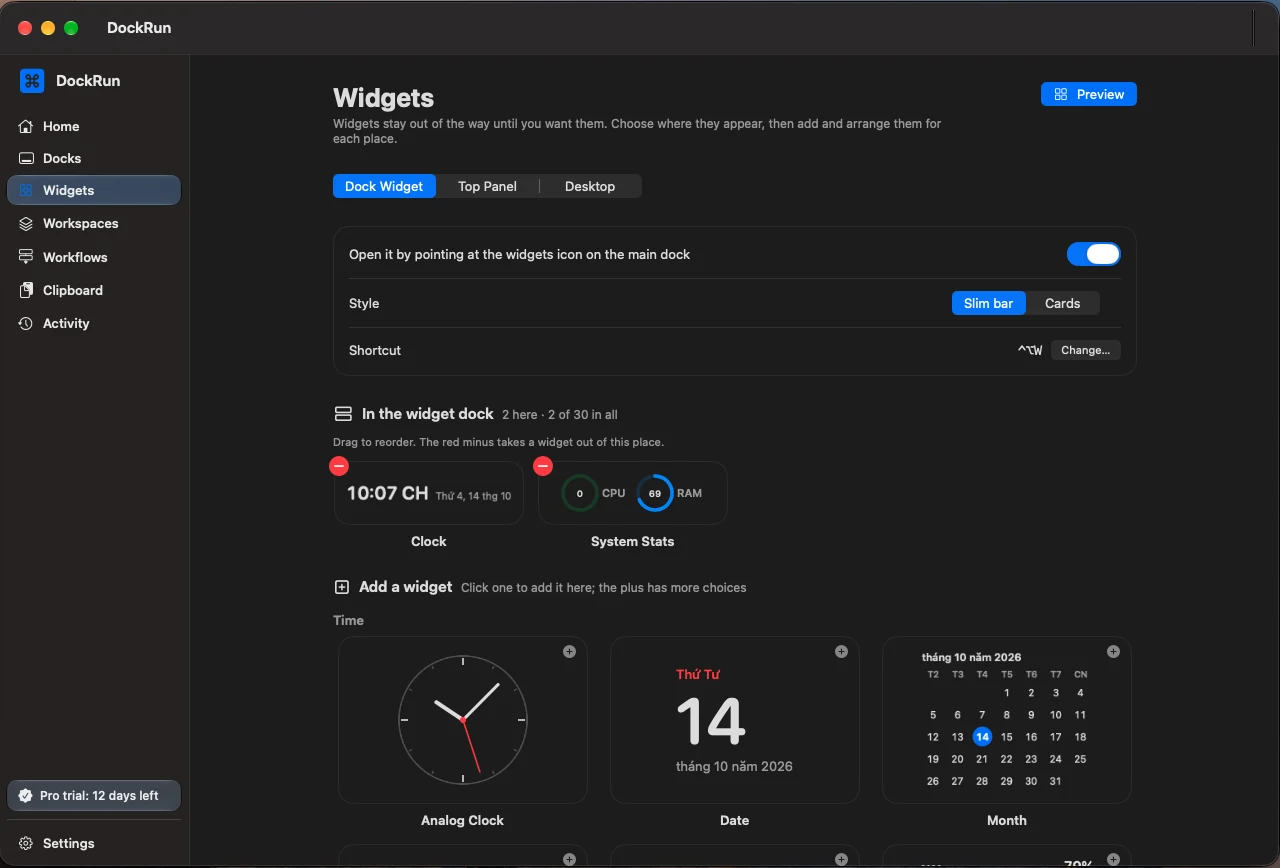
The DockRun widgets page with the clock and system stats widgets

21 built-in widgets

Clocks, system monitors, notes, a timer, now playing, stocks and more, all in one library. Add, remove and reorder them from the Widgets page.

  • Time: Clock, Analog Clock, World Clock, Date, Month, Year Progress, Timer
  • Monitoring: System Stats (CPU and memory), Battery, Network, Disk
  • Productivity: Calendar, Shortcut, Web Search. Utilities: Notes, Clipboard, Weather
  • Media: Now Playing for Music and Spotify. Finance: Stock, Watchlist, Currency converter

Where in the app: DockRun window > Widgets

Three places for widgets

The same widget can sit in the widget dock beside your main dock, in a panel at the top of the screen, or on the desktop. You choose per widget.

  • Widget dock: hidden until you point at the widgets icon, click it, or press ⌃⌥W (changeable in Settings > Shortcuts)
  • Top panel: rest the pointer at the top edge. It has a search box (apps, files, workspaces, workflows) and a file shelf of up to 24 dropped files that survive restarts
  • Desktop: draggable panels, behind or above other windows, on the display you pick; the position is remembered per display
  • A widget can be in the dock bar, the top panel or both; the top panel is off in full-screen apps

Where in the app: DockRun window > Widgets (dock bar, top panel, Desktop)

Clipboard history

Search what you copied, pin items and copy them back. It is off until you turn it on, and from the shortcut it works as a quick picker.

  • Records text, links, pictures and files (for files only the paths, never the contents)
  • ⌃⌥V opens it from any app: ↑ ↓ and Return copy the item and return you to the app you were in to paste
  • Keeps 10 to 500 items (default 100) plus pinned ones; pictures share a 64 MB budget
  • Skips copies that apps mark secret and anything from 1Password, Bitwarden, LastPass, Dashlane, KeePassXC or Keychain Access

Where in the app: Settings > Clipboard

Keep history across restarts

Pro

By default the history lives in memory only. In Pro you can keep it between launches, saved encrypted. The free version keeps up to 50 text items for the current session.

  • Saved on this Mac, encrypted with AES-GCM; the key is kept only in the Keychain
  • Turning the option off, turning history off, or clearing deletes the saved copy and the key
  • Free: text only, 50 items, this session. Pro lifts all three limits

Where in the app: Settings > Clipboard > Across restarts

Folders on the dock

Click a folder pin to see what is inside without opening Finder.

  • Lists folders first, up to 40 items; click an item to open it
  • Open in Finder is in the list and in the right-click menu
  • Turn it off with Folders show their contents

Where in the app: Settings > Dock > Folders show their contents

Permissions only when used

DockRun starts without asking for any permission. macOS prompts appear only when you use a feature that needs one.

  • Accessibility: placing app windows, keeping windows clear of the dock, sending keyboard shortcuts
  • Automation (Apple events): the Now Playing widget, asked once per player
  • Calendars: the Calendar widget asks before reading your calendar

Privacy: data stays on your Mac

DockRun keeps its data on this Mac and has no analytics. The network is used only for the features below.

  • Your Anthropic API key for the AI planner is stored in the macOS Keychain only; the planner sends your request and action names, not files, clipboard or history
  • Weather sends your chosen city to open-meteo.com; stock prices come from Stooq and exchange rates from open.er-api.com, only while those widgets are in use
  • Settings > Data & Privacy: turn history and recent items off, clear history, hide DockRun from screen capture
  • Export Diagnostics saves versions, counts and error codes, never your history, file names or API key

Where in the app: Settings > Data & Privacy

Back up and move your setup

Pro

Export your settings, or back up all workspaces and workflows to one file and restore it on another Mac.

  • Export Settings / Import Settings: settings only, no history, pins, workspaces, workflows or API key
  • Back Up Workspaces & Workflows saves a .dockrun file; Restore adds copies and never changes what you have, and workflows come back turned off
  • Exporting is part of Pro. Dock Style also exports a preset of the look (style, icon size, pins, custom icons)

Where in the app: Settings > Data & Privacy > Your data

Appearance

Follow the system theme or pick Light or Dark, and shape how the dock looks.

  • Theme: System, Light or Dark; Transparency slider from 30% to 100%
  • Dock Style: Liquid Glass, Solid or Transparent background and nine colour themes
  • The same style applies to the widget bar and the top panel

Where in the app: Settings > Appearance, Dock Style

Trial, one-time Pro, refund

Everything is unlocked for 14 days from first launch. After that DockRun returns to the free version unless you buy Pro once.

  • Pro is a one-time purchase for 1, 3, 10 or 30 Macs; a license can be deactivated in Settings > License to free a Mac's seat
  • 14-day refund; a refunded license returns that Mac to the free version
  • Free limits: 1 dock, 3 workspaces, 2 workflows, clipboard of 50 text items per session

Where in the app: Settings > License

How it works

  1. Pick your widgets

    Open DockRun window > Widgets and add the ones you want. Choose for each whether it goes in the dock bar, the top panel or both.

  2. Place some on the desktop

    In Widgets > Desktop, drag a widget where you want it, pick the display, and choose whether it stays behind or above windows.

  3. Turn on clipboard history

    Switch it on in Settings > Clipboard. Decide whether to keep it after you quit; it is off by default.

  4. Reach it with a shortcut

    Press ⌃⌥W for the widget dock and ⌃⌥V for the clipboard picker. Both can be changed in Settings.

A day with it
You keep System Stats on the desktop behind your windows and a World Clock in the top panel. While writing a report you copy three links and a screenshot, press ⌃⌥V, pick the second link with the arrow keys and Return, and paste it. The password you copied from 1Password never shows up in the history.

DockRun vs the macOS Dock

DockRun sits next to the Dock, or replaces it on screen. Here is what each does.

CapabilitymacOS DockDockRun
Open apps, folders and links from the dockYesYes
More than one dockNoYes
Launch a set of apps and arrange their windows in one clickNoYes
Live widgets (calendar, clipboard and more)NoYes
Clipboard historyNoYes
Multi-step workflows and scriptsNoYes
Command paletteNoYes
Built into macOS, nothing to installYesNo

Free vs Pro

Everything above that is not marked Pro works on the free plan.

Free

$0

  • 1 dock, as many pins as you like
  • 3 workspaces and 2 workflows
  • Command palette and Save Setup for open apps
  • All widgets, themes and Dock Style
  • Clipboard history: text, 50 items

Pro

From$12$19one-time, no subscription

  • As many docks as you need
  • Unlimited workspaces and workflows
  • Shortcuts, schedules, dockrun:// links
  • Arrange windows, close workspaces, run scripts
  • Save Setup with folders and browser tabs
  • Clipboard images, files and saved history
  • AI planner (your own key) and MCP
See pricing and buy

Questions, answered.

Need help installing? Read the install guide

Try it on your Mac
in two minutes.

Free to start. 14-day money-back guarantee on Pro.

Curious if DockRun is right for you?

Let ChatGPT, Claude, or Perplexity look into it - click below and see what AI actually thinks about DockRun.

DockRun features: docks, workspaces, workflows and widgets for Mac